
Field Notes
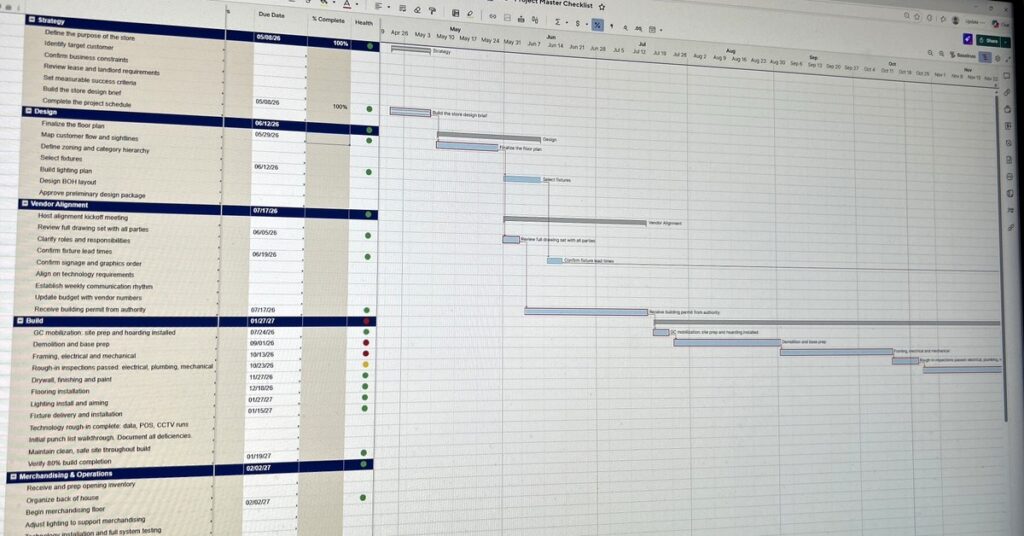
The opening date came first. It was chosen to line up with a major event in the city in June. It was a good reason to want a date. It had nothing to do with what it would take to build the store.
That distinction sounds small. On a 15,000-square-foot flagship, it decided almost everything that followed.
A date chosen for a moment works backwards from the moment. A date chosen for a store works backwards from the work: when the space is handed over, what demolition finds, how long the trades need, when the fixtures can arrive, when inspections can happen. The first kind of date asks the team to make it true. The second kind asks the team whether it is true.
Ours was the first kind.
The project ran under COVID restrictions, through shutdowns and a supply chain that could not promise anything. Demolition found structure hidden in the walls that the drawings did not show, and parts of the store had to be redesigned. The fixture supplier was vague about what it could deliver and missed the one date it did give. Every one of those problems was real, and every one was raised. Each time, the answer was a new date, chosen the same way as the first: closer than the work allowed.
What finally moved the date was not the advice of the people building the store. It was a trades strike that stopped work on site. A strike was the first delay nobody could argue with, so it was the first delay anyone accepted.
It also cost more than the weeks it lasted. When it ended, some of the trades went back to finish other jobs first. The sequence of work had to start almost from the beginning. A construction site is not a machine you restart by turning a key.
That told me something about how the date had been set. If expert advice cannot move a date and an outside event can, the date was never connected to the work in the first place.
The next date was early August, in time for back to school. When that slipped, leadership wanted early September. We said November. We settled on October, which was a mistake. In August I gave a date built from what the general contractor and the architects were telling us. I was told the date was mid-October. The store opened on the day I had given.
The real cost of a date like that is not the delay. It is everything you trade to protect it.
We paid for speed, and the change orders piled up. The HVAC units and the electrical panels both needed replacing, but new equipment was stuck in the supply chain, and waiting for it would have pushed the opening again. So the HVAC was repaired and the panels were reused. The units have since failed, and the panels gave the store trouble. On opening day, parts of the fixture package were missing, and we filled the gaps with fixtures pulled from other stores.
The store opened, and most customers would never have noticed what was missing. The team running it did. A flagship is meant to show a community what the brand is. This one arrived carrying problems behind the walls that it would live with for years, and many of them were decided by the date, not by the design.
On the projects that came after, we set dates differently. That store was the start of new processes, built on what it taught us, and they brought efficiency and cost savings to the builds that followed.
The date still started as a goal. A business is entitled to want a store open for a reason. But the goal was tested before anyone committed to it. Site conditions were documented during demolition, not discovered during construction. We sat down with the architects, designers and the general contractor to agree how long demolition and construction would really take. Pre-build estimates were held to strict guidelines and reviewed. Bids were checked for missing scope. Vendors were scoped properly, and the scope of work in the winning bid was written so everyone read it the same way.
Then the bids told us whether the date was real. If several vendors showed it could be done, we kept it and held them to it. If they could not, we reviewed the date instead of pushing harder. Enough pressure to test the schedule. Enough flexibility to change it when the work said no.
That is the difference. A date is a decision like any other. It can be set for a good reason. It just has to be checked against the work before it becomes the plan, by the people who will have to build to it.


Be the first to comment